I spent the better part of the last year using Claude for marketing workflows. Wiring Claude into live client work, breaking things, fixing them overnight and slowly arriving at a set of patterns that actually hold up under real production pressure. What I learned is that the gap between “using AI for marketing” and “building a marketing system powered by AI” is enormous. Most teams are stuck on the first side of that gap, re-explaining their brand voice in every chat window, copy-pasting between tools, and wondering why the output still feels generic.
Using AI in marketing is evolving far beyond the realm of basic, prompt-and-response chatbots. Organizations are shifting toward “Agentic AI” systems that possess memory, planning capabilities, and the ability to execute multi-step goals over time. To build a robust, scalable marketing engine with Anthropic’s Claude, you must transition from ad-hoc prompting to developing structured “Skills,” leveraging the Model Context Protocol (MCP), and deploying specialized AI agents overseen by human Subject Matter Experts (SMEs).
This article is the blueprint I wish I had when I started. It covers the architecture, the integration layer, the agent patterns, and the human oversight that makes all of it trustworthy and scales effectively.
1. Standardize Workflows with Claude “Skills”
Instead of re-explaining your brand guidelines, target audience, and formatting preferences in every single interaction, you can teach Claude once by building a Skill. A skill is a packaged set of instructions, structured as a simple folder, that teaches Claude exactly how to handle specific, repeatable marketing workflows.
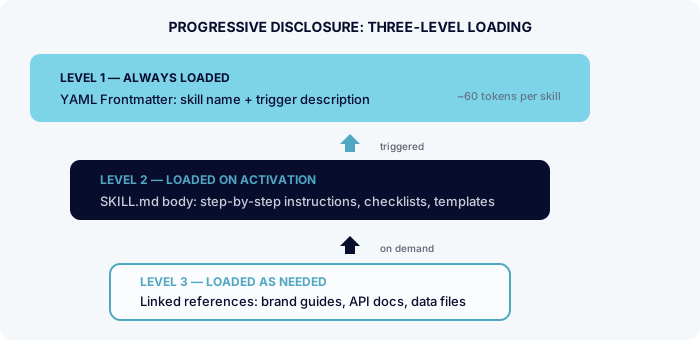
To prevent Claude’s context window from getting overwhelmed, a well-designed skill relies on a principle called Progressive Disclosure, which uses a three-level system:
YAML Frontmatter: This sits at the top level and tells Claude what the skill does and exactly when to trigger it, ensuring the skill only loads when relevant.
SKILL.md Body: This contains the actual step-by-step instructions, quality checklists, and templates that Claude reads only once the skill is activated.
Linked References: Deep-dive documentation (like brand style guides or API references) bundled in the skill directory, which Claude navigates only when it explicitly needs to.
2. Connect Your Data via MCP and RAG
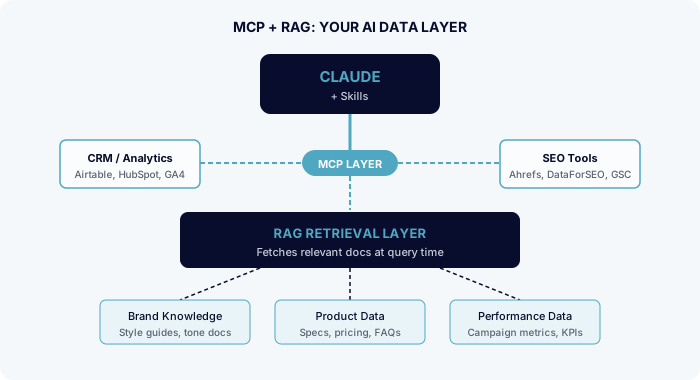
For Claude to be a true marketing partner, it needs real-time access to your actual data and tools. This connectivity is achieved using the Model Context Protocol (MCP), an open-source standard acting like a “USB-C cable for AI”.
Think of MCP as your professional kitchen: it connects Claude directly to your raw ingredients and equipment, such as your project management software, analytics databases, or CRM. Your Claude Skills, in turn, act as the recipes that teach Claude how to cook with those specific tools.
To scale this further, you can implement Retrieval-Augmented Generation (RAG). RAG infrastructure automatically feeds real-time, custom brand data and knowledge base files into Claude during the generation process. This prevents Claude from relying on outdated internet data, greatly reducing hallucinations and ensuring your content is factually aligned with your specific products.
3. Deploy Specialized Multi-Agent Swarms
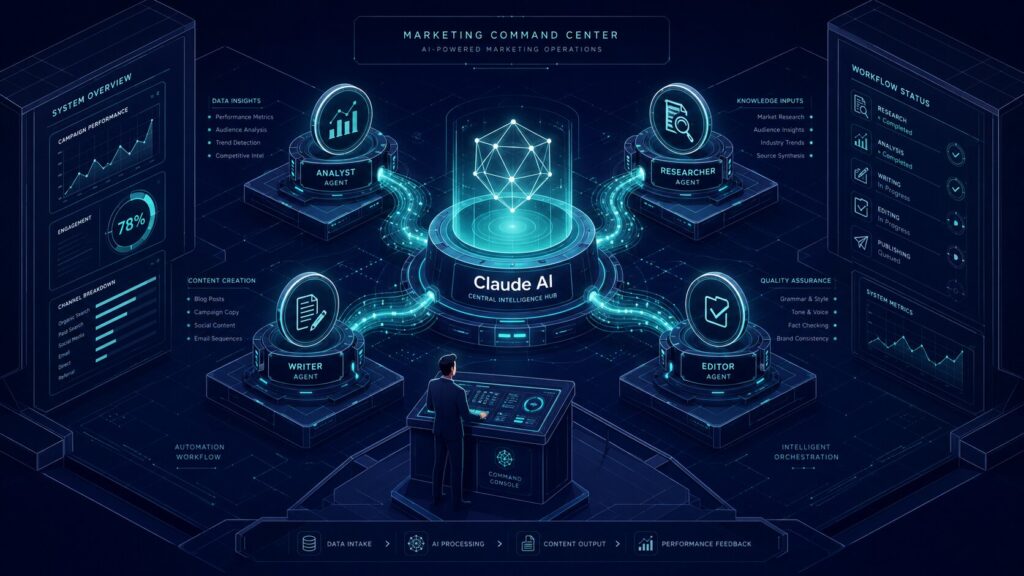
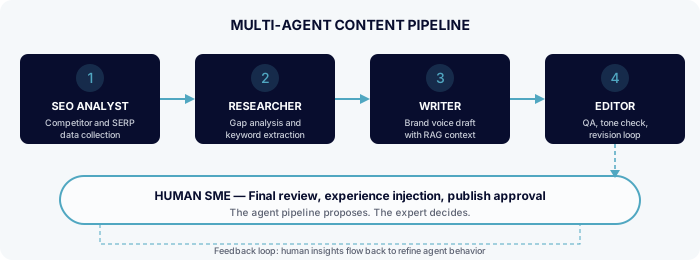
At an enterprise scale, you don’t rely on a single, generalized AI. Instead, you build a swarm of specialized AI agents that share intelligence and collaborate to accomplish complex goals. A scalable SEO and content pipeline can be divided into distinct automated roles:
SEO Analyst Agent: Polls search engine data to automatically identify the top-ranking competitor articles for your target keywords.
Researcher Agent: Takes the analyst’s data, performs a content gap analysis against your existing materials, and extracts keywords to find areas where your brand can add unique value.
Writer Agent: Drafts the initial content based on the researcher’s outline, incorporating your specific brand voice and internal RAG data.
Editor Agent: Acts as an automated quality-control check. It can analyze the writer’s draft for tonal inconsistencies, factual errors, or robotic phrasing, kicking it back for revisions before a human ever intervenes.
4. Power Predictive Personalization
As your system matures, Claude can analyze vast troves of customer data to drive growth through predictive analytics and hyper-personalization.
By integrating AI into your marketing stacks, you can automate real-time lead scoring and precisely calculate Customer Lifetime Value (LTV). These predictive insights allow the AI to dynamically adapt your omnichannel marketing. For example, AI can automatically segment your audiences and tailor individualized email or SMS sequences to specific users based on their predicted likelihood to churn, their browsing history, or their immediate mindset.
5. Keep Humans in the Loop (E-E-A-T is Non-Negotiable)
While this Agentic AI architecture dramatically scales output, you cannot set it and forget it. Search engines like Google are actively fighting scaled content abuse and aggressively downrank low-quality, commodity content generated purely by AI.
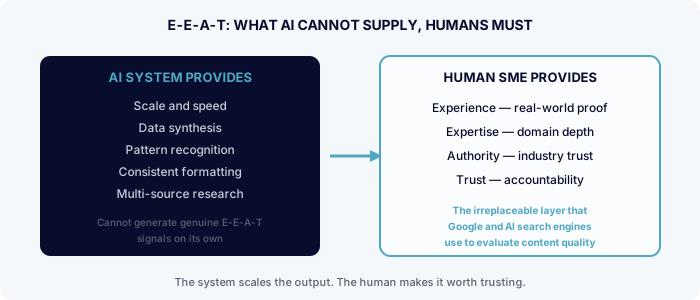
To succeed, your marketing system must adhere to Google’s E-E-A-T standards (Experience, Expertise, Authoritativeness, and Trustworthiness). Because AI merely synthesizes existing web data, it completely lacks real-world human experience and genuine expertise.
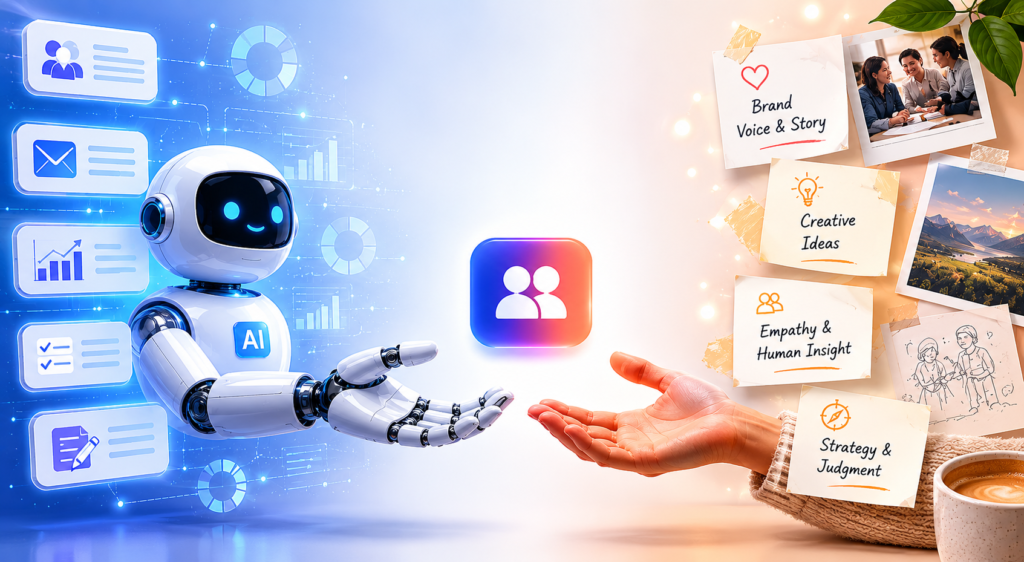
Therefore, human Subject Matter Experts (SMEs) must remain the ultimate gatekeepers. As marketing evolves, your team will shift from creating every piece of content to acting as “campaign conductors”, orchestrating AI agents, reviewing outputs, injecting unique insights, and ensuring the final product fosters genuine emotional resonance and trust with your audience. This is the centaur model of AI collaboration: the human brings judgment, experience, and accountability while the system handles speed and scale.
Stop Prompting. Start Building.
The difference between teams using AI as a novelty and teams using it as infrastructure comes down to one decision: will you keep treating every interaction as a one-off, or will you invest in the system that compounds?
Skills give you consistency. MCP gives you data access. Agents give you scale. And humans, your humans with real expertise and hard-won experience, give you the trust signals that no AI can fabricate.
The blueprint is here. The tools are available. The question is whether you’ll build the system, or keep paying the tax of starting from scratch every single time.
Let’s talk about building yours. Or start by exploring how AI search visibility is already reshaping the competitive landscape.