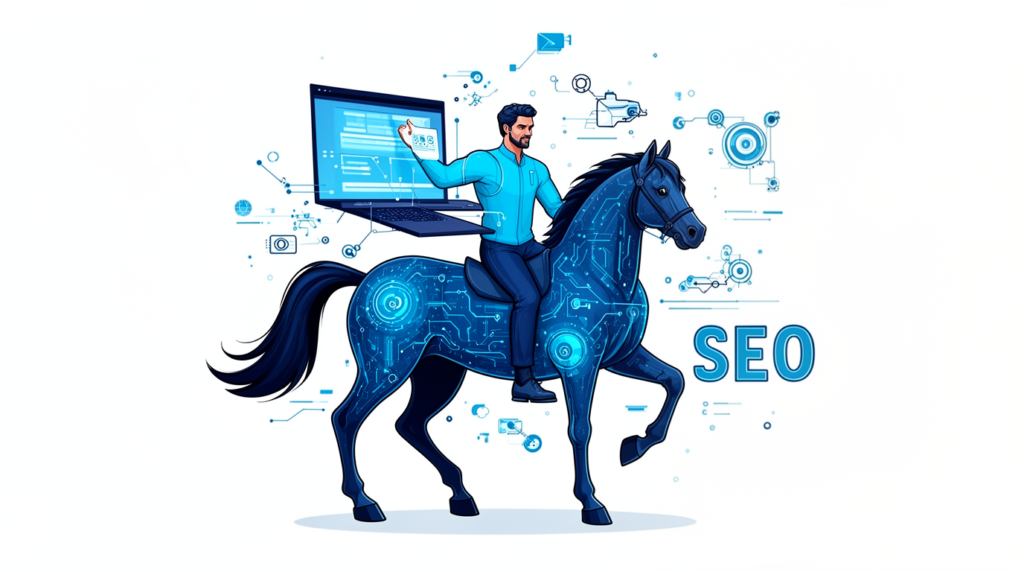
One would think asking AI to illustrate a centaur would not be that hard.
A centaur is a mythical creature, half man in the front and half horse in the back. Despite my best prompts the AI software I used to create the illustrated image above, could not get it right. It insisted that a centaur was simply a man sitting on a horse.
As funny as this is, when we use AI for SEO and business the success rate can’t be this dismal.
A year ago, the prediction was clear: AI agents would do everything. Give them a goal, step back, and watch them work autonomously. SEO professionals would become obsolete, replaced by systems that could research keywords, write content, build links, and optimise entire websites without human intervention.
That’s not what happened as shown by the cheerful man on top of a horse doing seo which is defintely not a centaur.
What’s actually emerging in 2026 is something far more interesting — and far more valuable for those of us willing to engage with it properly.
The Research Behind the Shift
A landmark study from Harvard Business School, MIT, and Boston Consulting Group tested 758 consultants working with AI on complex knowledge tasks. The results weren’t what you might expect.
Consultants using AI completed 12% more tasks, 25% faster, with 40% higher quality outputs. But here’s the critical finding: the researchers identified two distinct working styles that separated those who succeeded from those who failed.
They called them “centaurs” and “cyborgs.”
Centaurs — named after the mythical half-human, half-horse creature — maintained a clear division of labour. They knew which tasks to hand to AI and which to handle themselves. Cyborgs integrated AI into every step, working in constant back-and-forth dialogue with the technology.
Both approaches outperformed those who simply handed everything to AI and stepped back. The “self-automators” — people who let AI run autonomously — produced the worst results. They fell asleep at the wheel.
The centaur isn’t a compromise. It’s the optimal configuration.
What This Looks Like in Practice
I work in Answer Engine Optimisation — helping B2B brands get cited by ChatGPT, Perplexity, and Google’s AI Overviews. There’s a certain irony here that isn’t lost on me: I use AI to help brands get recommended by AI. It’s meta in the truest sense.
But this work has taught me exactly where the centaur model matters most.
More recent research from the Harvard/MIT team, published in Fortune in January 2026, found that centaurs achieved the highest accuracy of any group. By maintaining control over the analytical process and using their own judgment to evaluate AI inputs, they avoided being led astray by AI’s confident but sometimes incorrect recommendations. That mirrors what I see daily.
Large language models are exceptional at surfacing niche findings. They can identify patterns across massive datasets, spot opportunities in competitive landscapes, and generate hypotheses at a scale no human could match. When I’m analysing how AI platforms source and cite information across an industry vertical, an LLM can process and synthesise information that would take me weeks to compile manually.
Here’s what they can’t do: understand why.
AI doesn’t have access to a client’s full history. It doesn’t know about the rebrand from three years ago, the executive who left and took half the marketing team, the product pivot that happened six months before they came to us, or the internal politics that make certain recommendations dead on arrival. It doesn’t understand that the reason a competitor ranks well in AI citations isn’t because of their content strategy — it’s because their CEO has been a vocal industry commentator for fifteen years.
The cause still needs to be referenced as a human. And often, it can only be identified by a human.
This isn’t a limitation of current AI that will be solved with the next model release. It’s a fundamental asymmetry in information access and contextual understanding that makes human oversight not just valuable, but essential.
The Productivity Reality
Adopting this centaur approach has freed up roughly 30% of my working time. That’s not a small number when you’re managing enterprise clients and building strategic recommendations.
But here’s what matters: that 30% didn’t get absorbed by doing more of the same work at higher volume. It shifted entirely to strategy — the work that actually moves the needle for clients, and the work that’s genuinely difficult to automate.
The repetitive tasks that used to consume hours — formatting content calendars, running QA checks on briefs, standardising deliverables across clients — now happen with an LLM in the loop, with me validating outputs rather than generating them from scratch. The time I spent wrestling with spreadsheets now goes into thinking about what the data actually means.
This is the centaur trade-off in action. You’re not working less. You’re working differently. And if you’re paying attention, you’re working better.
A Necessary Step Back
The narrative around AI in 2025 was dominated by autonomy. Agents that could execute multi-step tasks. Systems that could research, plan, and implement without human intervention. The vision was seductive: describe what you want, and AI handles the rest.
We’re not there. And the organisations that acted as if we were have the scars to prove it.
What we’ve learned — through research, through practice, and sometimes through painful failure — is that the gap between AI capability and AI reliability is real. An LLM can generate a brilliant strategic recommendation and a confidently wrong one with identical certainty. It can surface an insight that changes your entire approach and hallucinate a citation that doesn’t exist. Without a human in the loop to validate, interpret, and contextualise, you’re not leveraging AI. You’re gambling with it.
The step back from full autonomy isn’t a failure of the technology. It’s a maturation of how we use it. The centaur phase isn’t a temporary waypoint on the road to full automation — it may well be the destination, at least for knowledge work that requires judgment, context, and accountability.
Anthropic’s CEO Dario Amodei recently warned that the centaur phase in software engineering might be “very brief.” Perhaps. But his own company’s models still require human oversight for anything consequential. The gap between what AI can do and what we should trust it to do alone remains significant.
What This Means for SEO Professionals
If you’re working in SEO, digital marketing, or any knowledge discipline, the centaur model isn’t optional. It’s the difference between using AI effectively and being replaced by someone who does.
This means developing genuine judgment about which tasks benefit from AI delegation and which require human control. It means staying close enough to the outputs to catch the errors that will inevitably occur. It means treating AI as a tool that amplifies your expertise rather than a replacement for having any.
The professionals who will thrive aren’t the ones racing to automate everything. They’re the ones who understand that the human contribution isn’t a bug to be eliminated — it’s the irreplaceable ingredient that makes the whole system work.
The centaur isn’t half-human because it couldn’t figure out how to become fully horse. It’s half-human because that’s what makes it powerful.
